Monday, June 20, 2011

Bus to Zacatecas


Cathedral and Cerro de la Bufa
 in the background
    Bus to Zacatecas

      From Aguascalientes I took a bus from the central Camionera north to Zacatecas, another colonial city built during the peak of silver mining activity.  Zacatecas is about 70 miles north of Aguascalientes and takes about two hours to reach.  Two ruin sites and a church were of particular interest to me, one ruin site is built directly on the Tropic of Cancer, the northern limits of what is deemed the tropics.
      ETN buses run regular service many times daily for 145 pesos for the 2-hour trip.  This works out to be two pesos per mile for high-quality, first class service.
      Zacatecas churches are of interest because of the opulent interiors built when gold and silver mining made the city rich.  The churches were built of pink stone, often pink volcanic cantera  which gives the historic center of Zacatecas a sense of cohesiveness, no building more impressive that the baroque cathedral in the center of the historic district.
     The Cerro de la Bufa and several other hills surround the old section of the city which is built in a low area within the surrounding gold and silver mines.  These eighteenth century mines provided riches for the construction of many now preserved buildings.
      Nomadic people lived in the area 10,000 years ago and at around 2000 BC built more permanent settlements in what is now called Zacatecas after the Zacateco Indians who among others such as Nahuatl speaking Chicamecas lived in the area when the Spanish arrived.
Santo Domingo Church
     The local indigenous people had been mining the area for years but the Spanish took that over soon after they discovered silver on Cerro de la Bufa.   By 1550 the town that grew around the mining operation  was well established.

      In the 1960s the city built a cable car called El Teleferico that runs from Cerro El Grillo to Cerro de la Bufa.  At the top of the la Bufa hill a statue commemorates a 1914 victory by Pancho Villa during the 1910 Revolution.  El Grillo, the hill opposite, is the site of the Eden Mine, one of Zacateca's most successful operations.  The mine started producing silver in the 1580s and continued to operate until the 1960s. The mine now hosts tours
     Two entrances to the mine are open for tours and one offers a short train trip to the gem museum, and the start of a walking tour into two levels of the mine.
The La Bufa hill at the opposite side of the Teleferico ride offers a museum that chronicles the battles fought in the area during the 1910 Revolution and the 1926 Cristero War.  The top of La Bufa offers a great view of the city of Zacatecas and can be reached by road, by a walking trail, or by the cable car. There is a zipline ride available at the top of the hill La Bufa.


     The cathedral, Zacateca's most notable building was first built in 1657 on the base of an existing indigenous ruin, as was the custom of the Spanish colonizers.  A second building was built in 1612 and in 1729-1754 the building now on the site was constructed.
     Another notable church with carved and gilt alter pieces is the Temple of Santo Domingo  built in 1746.  The eight side altars are carved wood in Churrigueresque style covered with gold leaf.  The nearby Pedro Coronel Museum houses the artists work and his collection which includes work by Picaso, Degas, Dali and others.
     From Zacatecas, the Chihuahuenses Bus, a division of Estrella Blanca Bus, reaches  the 40 miles to Somberete where a local bus serves to the town of Chalchihuites.  From there, cabs reach the ruin of Alta Vista, an intriguing ruin claimed by researcers to be a solar observatory built directly of the Tropic of Cancer.


Alta Vista Ruin Next  

Saturday, June 4, 2011

Bus to Aguascalientes


Bus to Aguascalientes

Aguascalientes Cathedral
      Many bus companies serve Aguascalientes.  Chihuahuenses, Primera Plus, and omnibus run buses from Mexico city north and west.  Primera Plus reaches Aguacalientes with several trips each day from Guadalajara that take three hours and cost 216 peso.      
      Primera Plus goes as far north as Mazatlan, Chihuahuenses reaches the border of the US.
       I took a cab into the center of Aguascalientes and read the tourist brochure on the way.  Aguascalientes was founded in the 1570s and later became the capital of Aguascalientes State.
I was happy to learn that the city is blessed with many pedestrian only streets and a huge plaza in the historic center. Automobile traffic goes under the plaza in a tunnel and this has created a spacious walking area in front of the cathedral.

      The mountain climate at over 1800 meters above sea level (6200 feet) is temperate at the coordinates of 21° 51′ 0″ N, 102° 18′ 0″ W 21.85, -102.3 where the city is in the center of Mexico's Alto Plano.
   

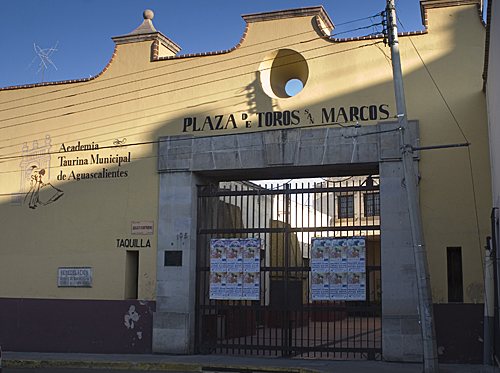
  Of note to visitors walking the city are the sections of the city or barrios that include Guadeloupe and its old cemetery, San Marcos for its gardens and baroque church, and the San Marcos Fair, an annual festival celebrated the last two weeks in April. Visitors can walk from the main square towards the San Marcos Gardens and then through the gardens to the baroque church and another extensive pedestrian only area of restaurants and clubs. The plaza de Toros is along the way as are many shops and restaurants that line the pedestrian only area that leads to a second bull ring.
One of two bull rings in Aguascalientes

Aguascalientes is located on the Alto Plano which is an earthquake belt with much geothermal activity. The region was named for the hot springs that continue to draw tourists to the spas. The hot springs led to the citizens of the city being called by some, hidrocalidos, or hot water people.

       Modern industry and manufacture have made Aguascalientes a prosperous city. Preservation of its historic center and colonial architecture have made the city a destination for tourists.

San Marcos Gardens
      Aguascaliente's most notable tourist event is the San Marcos Fair. This two-week music and performing art event takes over the pedestrian center of the city during the last two weeks of April. The fair attracts millions of tourists each year to the many performance events, concerts, bullfights, and crafts booths that spread throughout the historic center in the area of the Central Plaza and the San Marcos Church.

      The oldest buildings in the historic center are the 1575 baroque cathedral and the 1664 Government Palace. The palace is notable for its many arches within the interior.

        Next to the Cathedral, the Teatro Morelos is famous as a convention place during the planning of Mexico's political direction after the revolution of 1910. The center has a small museum.

     It is in this area and throughout the pedestrian areas between the Cathedral and the San Marco Church that the San Marcos Fair holds its many events from mid-April to early May.

     The Aguascalientes Museum, the Museum of contemporary Art and the discovery Museum offer exhibits.


Shopping in Aguascalientes, Avenue Benito Juarez,
 a pedestrian-only street and shopping area 
       The Ojocaliente is one of the original bathhouses and is still in use with its natural springs that feed the spas from hot water bubbling from the geothermal activity below ground.

     Another interesting tourist visit is the old railroad station and the antique steam engine. Aguascalientes produced steam engines for much of Mexico   and South  America.

    I knew that I would be returning to Aguascalientes to continue my trip east so I spent just half a day in the city walking the pedestrian only streets.  I caught a taxi back to the Aguascalientes bus terminal and from there I caught a bus to Zacatecas.