Monday, April 25, 2011

Patzcuaro Hotels and The Ruins of Zintzuntzan

Patzcuaro Hotels and The Ruins of Zintzuntzan


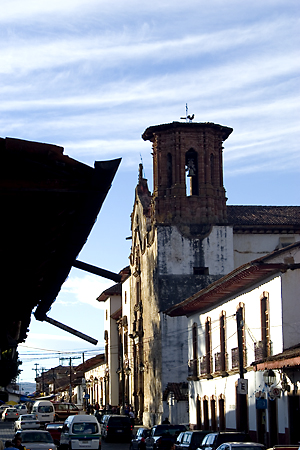
     The town of Patzcuaro can take you back 300 years to the Spanish colonial era. If it were horses instead of automobiles chugging down the narrow cobble streets you would think that you were in New Spain in the 17th Century. Cars do clog the streets, however, and too many according to some local people who find the afternoon rush hour annoying. Combis, the shared taxis, make up a good portion of those cars and they go everywhere; they are a good resource, however, for the budget traveler.

     I arrived in the old plaza, the Central Plaza Viejo, (not called the zocalo in Patzcuaro) and started my search for a hotel. A big old posada (Inn) squats on one corner of the plaza and I went in to have a look. It sure was a great old building but a little too old for me although the price for a room at 150 pesos or12.00 USD was attractive and the rooms were adequate. I wanted WiFi so I moved on to look at three more hotels on the plaza.

Patzcuaro Hotel Casa del Refugio
dining room
      The Casa del Refugio caught my eye because it is a beautiful hotel in an 18th Century building facing the plaza and it is only in its fifth year as a hotel. The manager offered a special price on the rooms so I asked to see a few and she escorted me to the second floor for a look. Double bed, large bathroom, TV with cable, ventilator, a beautiful restaurant on the first floor by a huge fireplace, and in-room WiFi; it was spotlessly clean and elegant with rich carved wood doors, historic artwork on the walls, and warm brown tile floors; I booked two nights.

      Once settled, I walked the town and found it easy on pedestrians. I toured the buildings fronting the new and old plazas, a block from one another in the center of Patzcuaro. A plaza-side restaurant beneath the portales on the new plaza offered a blackboard-announced, comida corrida, a fixed price, several course meal of the day. That afternoon it was a fish dinner for 70 pesos: (5.90 USD) soup, fillet of Dorado, rice, vegetables, desert, and coffee.

      After dinner I hunted for a cab driver who might give me a private tour in the morning. I met an amiable driver who could pick me up at my hotel at ten in the morning. He would charge 150 pesos per hour. He did not speak English but I looked at this as a chance to practice Spanish, which one must do continually to make any headway towards fluency.

        Usually when I visit a town or city new to me, I hire a cab driver for 1-3 hours to get an overview of the area, to learn about the local culture, and to find places that might not be on the tourist track. The cabdrivers all over Mexico charge between 100 and 200 pesos per hour. This is a good bargain usually, because you have flexibility. You might be able to book a tour with a tourist agency for less so it is good practice to visit a travel or tour agency in downtown to asses the options.

      The cab driver turned out to be a resourceful guy who knew the city after 20 years living there while he raised three sons. Of course he had his own notions of what I should see and his priorities didn't always resonate with mine. After one lengthy stop in front of an ugly old industrial building with him not understanding why I didn't jump out to snap photos, I learned that it was the technical school that his son had attended and he had left a ton of loot with that building over three years.  To him it was the most important shrine in town.
     When hiring a cab for a tour it is helpful if you have done some prior research and have a few target locations.

     We arrived at the Ihuatzio Ruin Site only to find the gate locked. I was ready to hop the fence but the cab driver said, "No problem," as he went down the street to find the guy with the key. I soon had the ruin to myself.

      We next visited several churches and I realized that except for a few hilly streets, Patzcuaro is easily walkable.

Patzcuaro and the Ruin of Tzintzuntzan near lake Patzcuaro
 

 The following day I caught a combi out to lake Patzcuaro and the ruin of Tzintzuntzan. This involved a combi to a stop called station and then a small bus to the town of Tzintzuntzan.

     While I looked at a 1000-year-old tea service in the Tzintzuntzan museum I was reminded of the elongated necks and spouts of Song Dynasty ceramics. The museum displays some elegant ceramic vessels that demonstrate well-advanced technique by the Tarascan ceramists.
     The name Tarascan is actually a misnomer tacked onto the local Perepecha speakers by the Spanish colonists.  Researchers believe that the Tarascan may have immigrated from South America due to similarities in pottery styles and in the language spoken by the Tarascans. The local Perepecha is similar to a Quechua language of South America. The ceramic and metal work of the Tarascans was unique in Mexico and the area today is still noted for the fine ceramic work of the local artisans.

     The ruins also demonstrate a link to distant areas. They are unique structures in Mesoamerica, round on the side that faces the lake and rectangular on the opposite side where a stairway leads to the top of the platforms. There are no other buildings like them in Mexico and researchers believe that Tzintzuntzan had been a ritual center of the Tarascan people during the post classic apex of their reign in West Central Mexico.
     The Tarascans, I learned, flourished from 1100 AD to 1530AD and had resisted an Aztec invasion in the 1400s. They remained free while most other cultures in Mexico became tribute-paying subjects of Aztec rule.

     The Tarascans could not hold out against the Spanish, however. The conquerors of the Aztecs brought European diseases in the 1520s that the Indians had no defense against. Illnesses depopulated the area. The people abandoned their buildings and disappeared into the hills, devastated by measles  and smallpox. Later arriving priest brought the people back and helped them renew their excellence as artisans.

     I walked the access road back from the ruins and took a set of steps to an artisan street where carvers worked with wood. Further on I came to a park where I asked a female police officer where I could get a taxi back to Patzcuaro.

     "You don't want a taxi," she said, "You want a collectivo, It will save you money."

She then signaled a collectivo to stop and I was soon on my way back to Patzcuaro center.


Next, Bus to Moralia

Monday, April 18, 2011

Bus to Patzcuaro and Zintzuntzan


Bus Stations, Zihuatanejo

     The morning of my first bus ride dawned with crisp light through the palms of my posada.  I hurriedly showered and packed; I knew Rene would be on time; Mexico's cab drivers are professional family men, usually, and they are more apt to be early than late.
     Sure enough when I stepped outside at 7:30 am onto the cobble sidewalk he was parked and waiting. Within minutes we were off to the bus station to catch the early bus out of Zihuatanejo.
 
     At Zihuatanejo's Central de Autobuses (bus station), many bus lines serve much of Mexico including Primera Plus Bus (Flecha Amarilla), Autovias Bus, Turistar, Futura (Estrella Blanca), Tap, La Linea Plus, Costa Line, and Parhikuni Bus. There are other bus stations in Zihuatanejo; it depends on the bus line that you prefer and your destination. The cab drivers always know which station you need.
    
     We arrived at the terminal and I shook Rene's hand and thanked him. I wanted to lay a five spot on him for great service but was reminded of Wilson's words to Macomber from the Hemmingway short story I had been reading the night before, "You don't want to spoil them." To hell with Hemmingway I thought, this guy spoiled me with his great service.

Central de Autobus,  Bus Station
     At 8:00 Am, the Parhikuni Bus pulled out of the Central de Autobus (Bus Station) and headed northwest along the coast road. We made a stop after a few miles at the resort of Ixtapa to pick up passengers and then continued north towards the city of Lazaro Cardenas.
Play la Ropa, Zihuatanejo
     After Lazaro Cardenas we hooked up with the toll road, Route 37, and headed north towards Uruapan. We were now headed inland and we began to ascend into the mountains. We would eventually rise from sea level to drive through valleys below mountains that ranged to 8000 feet. We had started across the great plateau that is the central spine of Mexico, the area called the Trans Volcanic Belt, the high plain, or Alto Plano. Along that belt of volcanic mountains, gold and silver built Mexico's richest colonial cities.


     My picture window view out the east side gave me a fine look at this beautiful country. I was reminded of Provence, high and dry, higher than the Alpilles, however, and drier. Still the country was lush enough to support a few cattle that I saw thinly scattered in the valleys between the high mountains that loomed in all directions and reflected in the glassy surface of a man-made lake beside the highway.

Artifacts In the Museum at Zihuatanejo   
     We reached Uruapan in Michoacan State after three and a half hours.
     Uruapan is one of the many transportation hubs in Mexico that you might pass through on your way to somewhere else. The area is an interesting colonial town, however, and is most noted for the production and export of Hass avocados.  They also hold a two-week long Easter crafts fair in which native craftspeople from all over Mexico come to compete for prizes and to sell their wares.

     In Uruapan I would catch a local bus that leaves every fifteen minutes for the 35-mile, 40 peso ride to Patzcuaro. First class service is not frequent from Zihuatanejo to Patzcuaro and that is why Rene figured that the two buses would get me there early.  An option could be to bus to Morelia and then bus back via a local bus to Patzcuaro. I would later take a local bus from Patzcuaro to Morelia for the same reason; the trip is short and the bus leaves every 15 minutes.

Hotels
     On a bus trip, I try to plan the arrival in a city new to me during daylight so that I will have plenty of time to find a hotel. I usually look for a budget hotel and in Mexico it is  usually not necessary to have reservations except during the Christmas and Easter vacation weeks. Otherwise you just arrive for both bus transportation and for lodging.


     Unless I know the area or have a good reference or recommendation from a friend who has visited recently, I prefer to arrive at the Zocolo or historic center of the city and begin my search for a hotel. Usually the Zocalo or central plaza will have one or two hotels and the room rate will be negotiable. If you and the manager are marginally fluent in the same language, and the hotel is not nearly full, you can usually work a deal. I like to see the hotel and inspect the room before booking. I therefore rarely book ahead except during holiday weeks.


Patzcuaro

Hotel Discount
     If the price is 400 peso a night, I ask if there might be a special for 250 or I ask if there is a discount for more than one night. If the answer is no, I move on to the next hotel. Usually the answer is yes, however; there is a discount and you secure a room for a reduced price.

     This might not be comfortable for every traveler especially for couples or families that need that feeling of security that comes with knowing that you have a hotel room ready for your arrival.

      In smaller towns and cities you could ask the cab driver at the bus station for a recommendation. In the larger cities the drivers often take a commission from the hotel, however, so they might not have your interest at heart. In the smaller towns the cab drivers can often be trusted to give you good hotel advice.

Patzcuaro
I look for a hotel with a restaurant, rooms with hot water, TV with cable, a quiet room away from the main streets, and a ceiling fan. In the mountains you don't need air conditioning.   I also look for WiFi in room because I will be sending photos and text via the web.

Tipping
     The local people rarely tip a cab driver and will commonly tip at a restaurant 5 per cent or maybe 10 percent if they are from a large city. Tipping is up to you with 10 percent being considered max. Cab drivers do not expect a tip but if one has been helpful with the luggage or getting maps or giving good advice a tip may be appropriate.

     A driver like Rene in Zihuatanejo, who goes out of his way to help as he did for me when he went into the bus station and arranged my passage, deserves ten percent. When you consider that ten percent of a 40 pesos cab ride is 35 cents it does not seem an excessive tip.  Currency Converter


     I boarded a local bus at the Uruapn station and was soon in Patzcuaro where I left the bus after asking a man if we were near the center of town. He advised me to leave the bus and take a combi. (shared taxi van) This saved me cab fare from the bus station and I was soon in the old central plaza of Patzcuaro and looking for a hotel.


Next, Patzcuaro Hotels and The Ruins of Zintzuntzan

Monday, April 11, 2011

Bus Mexico's Pacific Coast, East to the Gulf Coast


Playa Principal Zihuatanejo    


Bus Pacific Coast to the Gulf Coast
     Mexico's first class buses are legendary for cheap and safe travel.
     I have bused the 2300 miles of the Pacific Coast several times while looking for the fishing villages and quiet beaches where I vacation for a few weeks. I have also toured the coast by camper on Coastal Route 200, going both north and south. I find, however, that the easiest way to travel Mexico is by first class bus.
      Buses use as hubs the once wealthy colonial cities of great historic interest along the coast, cities such as Acapulco, Manzanillo, and Mazatlan. These cities were seaport towns of Colonial New Spain's Asian trade with the Philippines and the spice islands.
     If you love history you will love these port cities where the Spanish built wooden sailing ships that left from their deep water harbors as seagoing traders.   The Spanish traders continued the journey that Columbus intended when they headed west to Asia, the Phillipines, and to the Moluccas or Maluka Islands in search of exotic trade goods and spices such as nutmeg, clove, and mace.  The ships returned with cargoes of silks, jade carvings, ceramic tableware, and exotic spices destined for the castles of the Spanish Kings.
      In their success the ships attracted competition from England and the attention of pirates, often one and the same. To counter the threat, forts once guarded the harbors from pirate attack. These forts are now historic museums, the most notable, Fort San Diego a 1615 garrison that was rebuilt in 1778 on a hill that overlooks  Acapulco Harbor.
Surfing Mexico's Pacific Coast


     During a recent Pacific coast beach vacation I decided to explore another dimension of the Spanish Colonial era; I wanted to bus to the inland mining communities where gold and silver once built wealthy colonial cities during the 16th and 17th century. I had my sights on places like Guadalajara, Morelia, Aguascalientes, San Louis Potozi, Zacatecas, and the richest mining town of all, Guanajuato.
     These cities are bus hubs in Mexico's extensive bus system. The elegant old colonial cities thrived on gold and silver mining that built baroque cathedrals replete with gold leaf interior detail.  The old church buildings were taken over by the government and now are museums and ornate old mansions that house cultural centers.
     In these old cities of Renaissance-style buildings, a visit to the downtown area seems more like a visit to a walled city of Europe than a tour of the central highlands of Mexico.

     From my posada in Zihuatanejo on the Pacific Coast I poured over the Guia Roji book of road maps while I planned a bus trip east across Central Mexico.


Tzintzuntzan Ruin Site, Patzcuaro       


      For my first stop I would head towards the nearest inland city, Morelia, which I would reach after a several-day visit to Patzcuaro. I wanted to visit again the ruins of Tzintzuntzan on the shores of Lake Patzcuaro. I hated to leave Zihuatanejo however, that is one great beach town.

     Each morning during my winter visit to Zihuatanejo I would walk the fisherman's trail along the beach for exercise.  I would walk a couple of miles or even more if I went all the way to the lagoon at the end of Playa La Ropa to feed the crocodile, although he is pretty well fed from scraps tossed out by the restaurant.
     From there I would walk back up over the hill and along the beach or I might catch a micro bus back to the fisherman's beach for breakfast at a beachside restaurant beneath an umbrella. Once at the restaurant I could sit for an hour or so and drink coffee after a breakfast of eggs and toast with strawberry jam while I watched the fishermen unload their catch.

     As the fishing boats came in from pulling longines and gill nets, the fishermen would set up an impromptu market under the shading palms. They displayed their fish in front of a parade of shoppers who came in to bargain over a fillet of sailfish, a game fish called locally Pez Vela, or to haggle over a kilo of dorado, a delicious blunt headed fish know in Hawaii as Mahi-Mahi.


Playa Principal Zihuatanejo   


The chefs from the local restaurants would send their helpers to scoop baskets of whole red snapper and to strap them to the backs of motorcycles for the trip to the restaurants for the afternoon huachinango specials.  Ladies ambled off to the their tiendas with a whole dorado slung over their heads or baskets of shrimp balanced on a ring of cloth arranged on heads that seemed immobile as they walked.
     Orange baskets were piled high each morning with fish and with the tentacles of octopus sticking out and wriggling to escape as they lined the seawall and waited for the market boys to haul them off.
     Around me each day at breakfast I could hear the symphony of friendly banter. The call of the sea birds as they swooped in for a bit of fish skin tossed from the cleaning tables added the treble notes and the breeze that came whistling down the deep bay from the open ocean to rustle the palms added the bass. I had my breakfast serenade each morning and I hated to leave Zihuatanejo.

     A friendly taxi driver named Rene Brooks Morales who I had hired earlier gave me his cell number, 755-108-7043, but I didn't need it.  I met him at the zocalo by chance the day before my planned departure and I asked about bus service east. He insisted on taking me to the bus station where he went in the terminal with me to help me book a bus to Patzcuaro, a place where he once lived. He asked questions that I might not have asked.

     This trip to Patzcuaro would include two buses, he advised. He planned to make it the shortest and yet the most scenic bus trip.
     The first bus would be a Parhikuni Bus to Uruapan for 315 pesos. ($30. USD) The bus would take the high-speed road to Uruapan and from there I would catch a local bus to Patzcuaro leaving every fifteen minutes and costing 48 pesos. ($4. USD)

Olmec stone sculpture, jalapa Museum
Veracruz State, Mexico 

Patzcuaro would by my first lengthy stop on a bus trip from west to east across what is called The Trans-Mexican Volcanic Belt, the high country of Central Mexico.
     My last stop before heading north to the border would be the Museum of Anthropology in Jalapa, Veracruz.  There I would marvel once again at the huge stone sculptures created by the Olmec culture 3,500 years ago.
    
     The great stone heads sculpted by the people we now call Olmec are realistic, three-dimensional works of art carved from 20-ton blocks of volcanic stone. Viewing them would be a fine ending to my tour of the great stone cities of Mexico.
     Be it baroque cathedrals based on the work of the Renaissance built by silver barons to honor their God or Olmec sculptures created uniquely in the delta of the Coatzacoalcos River, built to honor Mexico's first emperors, I would have  an unhurried look at the stone icons of Mexico during my trip.

     A Mexico bus trip would give me time to delve into Mexico's rich history, a deep one at that; the Olmec heads go back to 1,200 BC, nearly a thousand years before the Athenians built the Parthenon.
     Buses would take me through much of Mexico's history in stone, stone  pyramids,
stone sculpture, and baroque stone cities.   I planned to see as much of it as I could while busing west to east across the high plateau of Central Mexico


Next, Bus to Patzcuaro and Zintzuntzan