Tuesday, July 22, 2014

Guelaguetza Festival Schedule, July, 2014


Guelaguetza Oaxaca , Cultural Festival Of  Regional Dance, July 2014
Updated July 2014
Guelaguetza dancers perform in Oaxaca City.
 July 16th to the 30th is a festive time in Oaxaca 

Guelaguetza
Guelaguetza is a word for communal sharing in the Zapotec language.  The annual Guelaguetza celebration in Oaxaca City includes Zapotec, Mixtec, Chatino, Mixe, Chontal  and other indigenous groups who congregate in the city of Oaxaca to celebrate their agricultural way of life.
 The modern Guelaguetza is a celebration that includes performances by groups of dancers who come to Oaxaca City from the eight distinct regions of the State of Oaxaca where seventeen or so indigenous languages are spoken. 
The tradition goes back several thousand years to the thanking of the Gods for favorable crops and the communal sharing of gifts.
In the modern celebration the performers dance and enact stage plays and shower the audience with offerings typical of their region.  This is the essence of the Guelaguetza, (link) a sharing and reaching out in the spirit of community.

  • Guelaguetza Events
The Guelaguetza celebration starts with parades in the City of Oaxaca and then performances at the theater built in the 1970s on the hill del Fortin, above and to the west of the city.  The celebration is one of costuming and performing the regional dances.  The event includes the election of a woman chosen for her knowledge of the history of the traditions.  She  will represent the Corn Goddess.
     The parades start around the 15th of July.  There will be the election of the Corn Godess Centeotl.  This will take place in the Jardin Panuelito near the Santo Domingo Church in the morning during the second week of July.
  Folkloric Parades will take place on  Saturdays of the third and fourth weeks of July.  These parades form at the park of the Stone Cross on the pedestrian-only street Alcala or at the Llano Park and march to the Zocalo.
The feast of the Corn Godess and of the Virgin del Carmen take place around the 15th of July.  Parades are held on various dates (Check with the tourist office for exact dates and routes of the parades.  Parade routes and times can change and deviate from the published schedule)
The stage play depiction of the story of the Princess Donaji, the last Zapotec empress, takes place on the two Sundays before the two Monday Guelaguetza performances.

  • Parades
Parades take place on the two Saturdays before the Monday performances.
The parades form at around 6 to 7pm at the park of the Stone Cross or at the Llano Park.
The parades head south down Benito Juarez Avenue and Alcala to the Zocalo.
 Youtube,  Parade Video

The Parade of Delegations could include as many as 40 delegations represented.  The parades start at the Park of the Stone Cross near the Pochote Garden or at the Llano Park and walk to the Cathedral and the Zocalo  The two Parades of the Delegations take place the Saturday before the Monday Guelaguetza performance.
The staging area and route to the Cathedral and Zocalo can change depending on street conditions so it is best to check ahead at the tourist office.
(Check with tourist info as these dates and times could change.  See website listing below.  We will update these as dates are announced by the tourist agencies)


Guelaguetza 2014 Schedule and Ticket Price

2014 dates:  Two days of performances; July 21 and July 28,
Two performances daily, 10 am performance and 5 pm performance
Ticket Price:  Section A,  1237 Pesos, Section B, 960 Pesos,
Section C and D, free

    Book with TicketMaster


Parades, Saturday 19th and the 26th, forming between 5 pm and 6 pm at the Llanno Park. Parade route is south on Benito Juarez Avenue, around the Park Consatti, South on Benito Juarez, and then west on Abasolo to the pedestrian-only Alcala and then south to the Zocalo and ending in front of the Cathedral. 

  
  • Guelaguetza Performance
The Guelaguetza festival performance takes place on the first Monday after the 16th of July.  A second performance takes place on the following Monday.
 July 16 is significant as the day honoring the Corn Goddess Centeotl.
 The 16th of July is also the feast of the Virgin del Carmen (Virgin of Mount Carmel) in the Spanish Christian religion.  The Colonial Spanish combined the ancient religions and Christianity to make the 16th of July the important date of this event.
The Goddess is elected a few days before the start of the Guelaguetza. 
The date for the first performance of the Guelaguetza can change to the following Monday if the Monday after the 16th happens to fall on July 18th, the anniversary of the death of former Mexican President and Oaxaca native Benito Juarez.  The Guelaguetza event is also called the "Los Lunes del Cerro" or Mondays On The Hill.   

  • Princess Donaji Performance
 The Princess Donaji enactment takes place on the two Sundays before the Monday Guelaguetza.     8:00pm,  100 pesos for section A and B  (Proceeds benefit the Oaxaca old peoples home)
 Musical groups perform starting at 5:30 pm

  • Where
The Guelaguetza tradition has been combined with the Catholic Virgin del Carmen and as a result, one of the parade staging areas could be the church of Carmen Alto on Calle (street) Garcia Vigil.
The other staging area for the smaller parades is the Stone Cross Park.  The larger parades will form at the Llano Park, three blocks east of the Stone Cross Park.
The Saturday parades will form up in staging areas eight blocks north of the Zocalo at the Llano Park located on avenida Benito Juarez.   
 On Monday, the participants walk to the hill to the west of the city, Cerro del Fortin, and the auditorium, where the stage plays and regional dances take place.

  • Tradition
Regional dancers perform in the auditorium
and at locations around the City of Oaxaca
during the weeks of July 16th to the 30th 
This tradition is a continuation of ancient rituals based on the connection between the Gods and the favorable conditions for agriculture.  Corn was a primary crop of the ancients and was first developed or hybridized around 5,000 years ago in Oaxaca State.  There are long standing traditions in Oaxaca of honoring the Rain Gods and Corn Gods and of offering regional foods as gifts.

The Guelaguetza has become a popular cultural event throughout the country particularly after 1987 when Oaxaca reached UNESCO World Heritage status.  The modern, high-speed highway built in 1994 has made the event easily accessible to visitors from Puebla, Veracruz, and Mexico City.  Oaxaca's small but modern jet airport with direct flights from Houston and Mexico City has made the City of Oaxaca (link) a destination for international travelers.  
Rainy season will be well established by July so umbrellas could be important in case of afternoon showers.

Oaxaca Hotels      (links to Oaxaca Info)


Tourist Office, City Tourist Information  is a good source of up to date information
The City Tourist Office is located at 102 Matamoros.
They are across from the club La Tentation at the big i Between Calle (street) Garcia Vigil and the Alcala.
www.oaxaca.travel
 The State Tourist Office will provide information and ticket sales  They are located at the edge of Llano Park on the west side.


Monday, June 23, 2014

Bus Phoenix, AZ. to Mexico City

Bus Phoenix AZ to Mexico City 
Update 2014


Park in Aguascalientes.


Phoenix to Mazatlan 
    One of the popular routes to cross from the USA into Mexico is the route from Phoenix, AZ. through Tucson, AZ that crosses into Mexico at Nogales.  This crossing could be via Tufesa Bus, a cross-border bus that goes through Nogales and could include the red light/green light system at customs and an immigration check by US and Mexican officials.


  If you are vacationing in the USA and want to visit Mexico, the shuttle services located in Phoenix and Tucson and the cross-border Tufesa Bus service make it not only possible but fairly simple. The Tufesa Bus runs a bus route southeast on the Pacific Coast to Mazatlan and then inland to Guadalajara.
Tours in Guadalajara


 In Nogales, Mexico there are also Tap and Omnibus  (Estrella Blanca Bus) that run bus routes south and southeast through Mazatlan and through Chihuahua to Mexico City.

From Tucson there are two popular crossing routes offering transportation services, the crossing at Nogales and the one at Douglas Arizona/Agua Prieta, Mexico.  The best crossing point could depend on where you are going in Mexico.
 
Mazatlan

 If you are traveling to the Central Mexico Alto Plano and cities such as Chihuahua, Zacatecas, Aguascalientes, San Luis Potosi, and Mexico City, you might choose Douglas AZ/Agua Prieta border crossing as the quickest route. This is a distance of 1300 miles to Mexico City and is a little more direct for Central Mexico than the coastal route through Mazatlan and Guadalajara. The route through Douglas will take you to Chihuahua, Zacatecas and into Mexico City.
(and a whole lot Colonial Cities in between if you wish to tour.)


        The first leg of this trip could start with the shuttle from Phoenix or Tucson to the border.
I made this trip in April 2014, through Douglas AZ. with the Douglas Shuttle leaving Tucson at about 9 am. There are a few Douglas shuttles all located on or near South 6th Street in Tucson.
The Sun Tran Bus out of the Ronstadt Center in Tucson will reach south sixth.
The shuttle price is $25 for the two-hour trip to Douglas.
For Nogales the price is $12 USD.


     We arrived at Douglas AZ on the the Mexico/US border at 11:00 AM and I walked through without a check of any papers, or luggage.
     At the Douglas crossing I got a six-month tourist card. (permission to visit Mexico) $26 USD.  I went to an ATM in Agua Prieta at a bank a half block from immigration to get some pesos and then took a cab for 60 Pesos to the bus station, the Central de Autobus de Agua Prieta.
     At that bus station you find Estrella Blanca Bus running Chihuahuenses Buses and Futura Buses as far south as Mexico City.
Across the street find Omnibus first class buses running the same bus routes.
 I entered the Estrella Blanca station and handed the ticket clerk a paper with my name and destination.  The ticket price to Chihuahua was about 750 Pesos.
see Tips, destination and ticket price  

The bus arrived after a short wait.  I visited Chihuahua and Zacatecas on the way to Mexico City.


Related Links

Chihuahua Bus to Copper Canyon

Chihuahua.

Oaxaca Guelaguetza Parade July Youtube

Friday, May 30, 2014

Chacahua Lagoon Tours from Puerto Escondido

Puerto Escondido Chacahua Lagoon Tours
Zipolite is noted for its sunrises and sunsets

We booked an all-day Chacahua tour that included a guide, transportation, boat tour, and crocodile farm tour. The price was 500 pesos per person if we had three people. We needed at least one more and perhaps two to lower the price for each person. We did find a third and were on our way around nine am the next morning in the guide's car.


Route 200 northwest passes two large lagoons where migratory birds winter and nest: Manialtepec, at about ten miles out of Puerto Escondido, and the connected lagoons of Chacahua and Pastoria at about 45 miles out.

After an hour and a half, about five miles west of Rio Grande and 35 miles before we would have crossed the Rio Verde, called the the Rio Atoyac in Oaxaca City, we reached the crossroads for the village of Zapotalito, a village on the Laguna Pastoria. At Pastoria we boarded a small launch that took us to the village of Chacahua, located on a sand spit, barrier beach. 

To get there we crossed a great expanse of lagoons that included Pastoria and Chacahua on our way to the village. During the trip we visited the nesting areas of Ibis, white and brown pelican, roseate spoonbill, frigate bird, several types of egret, heron, and cormorant. The guide claimed that about 150 different land and water bird species made the area home. 


We could believe it when we approached the islands where the birds nested and were shocked to see surreal, glowing white lumps of land jutting from the blue waters. As we neared we realized that the guano of thousands of nesting birds that crowded into the islands had turned the trees and rocks white.


The not unpleasant smell of fish wafted in from the guano as the boat captain did his best to get us close for photos while our guide pointed out the many varieties of birds.


After a couple of hours of photographing nesting birds and wading birds we beached at the village of Chacahua for a visit to the crocodile farm. 


The preserve is attempting to re-establish the two types of crocodile native to the area that had been hunted to near extinction for their meat and hides.


How to reach Chacahua

From Puerto Escondido take a local bus that serves Pinotepa Nacional. Head to the town of Rio Grande and ask the driver to stop at the crossroads for Zapotalito, about five miles beyond Rio Grande. There will be taxis at the crossroads to take you the five miles to the village of Zapotalito. 

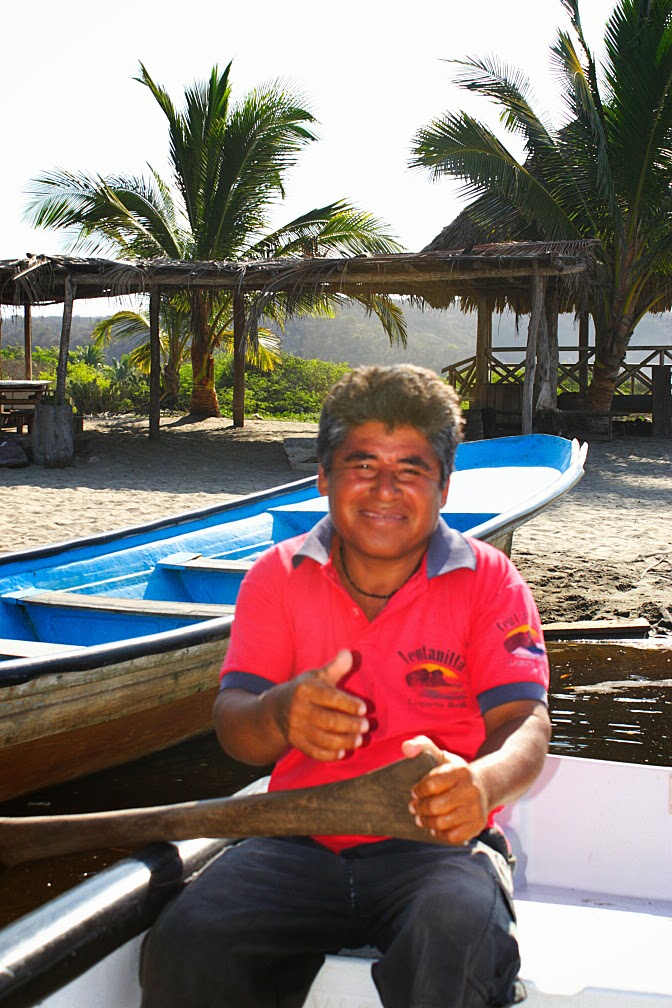
Local people resident on an island in the lagoon work
as fishermen and guides

Coming from Oaxaca City take Highway 131 over the mountains and through the town of Sola de Vega and connecting with Highway 200, the Cost Road between Puerto Escondido and Pinotepa Nacional . Head northwest on Route 200 for Rio Grande and the crossroads of El Zapotalito. 


Once you reach Zapotalillo, you will find parking and boat transportation for tours of the lagoons.


Related links

Tuesday, May 20, 2014

Puerto Escondido Ecotouring, Pacific Coast Oaxaca

Ecotour From Puerto Escondido, Pacific Coast Lagoons, Oaxaca


Sunset at Playa Marinero, Puerto Escondido
       In January we went to the Pacific Coast of Oaxaca to see the lagoons where exotic birds such as stork, roseate spoonbill, grey and white pelican, teal, egrets, heron, and frigate bird winter and nest. 


Zicatela Beach, Puerto Escondido, Oaxaca

     From Oaxaca City we took an OCC night bus to Huatulco where Sur Buses and local buses run north and south along Route 200 with stops in Pochutla, Mazunte crossroads, and Puerto Escondido.  We left the bus at Pochutla for the beaches of Mazunte, the turtle museum, and Ventanilla where our lagoon tours would start.


Ventanilla Lagoon Crocodiles


     A collective cab took us to the village of Ventanilla where a tour by boat through the lagoon got us a look at several crocodiles sunning themselves on the beach. 


     My companion on this leg of the trip was David Rice who had just backpacked from Antarctica to Prudhoe Bay and seen his share of wildlife along the way including penguin, grizzly bear, and wolf so as you might guess he wasn't too impressed with a few basking crocs.    
 See David's Book at Amazon


Our guide told us that the crocs don't
 hunt humans, they prefer stray dogs.

     On the way in to Ventanilla on the access road I saw a dog sniffing along the shoreline and thought that the edges of the croc lagoon is probably not a good place for a dog to be prowling. Sure enough the tour guide later told us that dog was one of the favorite foods of the 70 or so crocs that live in the lagoon.
These photos are from several trips to the lagoons over the last couple of years


     The crocs don't hunt man, the guide assured us, as we approached a few big crocodiles that were sunbathing on the shore. When we got close they would just scurry off into the water.


Puerto Escondido Lagoon Tour Chacahua


From Ventanilla we headed by taxi to the Route 200 crossroads and caught a Sur bus for the 35 miles northwest to Puerto Escondido to meet a friend from Europe and tour the lagoons of Manialtepec and Chacahua.


Sunset at Zicatela Beach

  
Clubs and restaurants on Zicatela Beach are great for sunset watching


Puerto Escondido,  Playa Marinero and Playa Principal
       In Puerto Escondido I met up with Renata and we did our swimming in the calm bays of Puerto Angelito and Play Marinero.

Puerto Escondido is known by most travelers for the surfing on Zicatela Beach and even travelers who don't surf visit to dip their toes into the Pacific beach where the legend of the Mexican Pipeline was born.   The previous year we arrived in time for the November surfing competitions and saw lots of wildlife but not of the animal kind. bikini contests, skateboard competitions, skydiving and of course the three days of surfing kept us busy. 
Puerto Escondido Camping  


Playa Marinero at Puerto Escondido is a small wave beach

Puerto Escondido Surfing


     We were visiting this time for the ecotours in the lagoons but watching surfers on Playa Zicatela is always fun on Puerto Escondido's surfing beach. 
Surfing competitions are held in August and again with the annual Zicatela Pro in November, an International competition attracting over 100 competition surfers.  


Zicatela surfing
     Zicatela Beach is open to the ocean to the southwest and can,  in the peak swell period of mid July through the August and September hurricane season produce twenty-foot tube waves.  Zicatela will regularly produce  eight to twelve-foot waves with an offshore wind blowing northeast and this makes it one of the worlds best surfing beaches. 

      Not being athletic swimmers we avoided the waves of Zicatela and stuck to the small-wave beaches at Playa Marinero and took taxis to the Carrizalillo and Puerto Angelito coves located in protected bays a mile northwest of the village center.

Puerto Escondido Diving


     Puerto Escondido has a PADI dive shop at the center of Play Principal. They will provide all equipment, lessons, local info and boat trips. Cove beach dive spots for snorkel are Playa (beach) Carrizalillo, and Puerto Angelito.


Lagunas de Chacahua National Park

Chacahua Lagoon Tour


After a couple of days of beaching we booked an all-day, Chacahua Lagoon  tour that included a guide, transportation, boat tour, and crocodile farm tour, for 500 pesos.

Our guide explained that over 150 species of birds 
inhabit the Chacahua Preserve
There is also a crocodile nursery located inside the 
Lagunas de Chacahua National Park

The boat captain knew where to find the birds and how
 to get us close for photographs 

Brown pelicans in Chacahua Lagoon

Related Links

Friday, May 9, 2014

Oaxaca Photo Walks

A Mile From Here, Oaxaca Photo Walks
David Hilbert

Walking the neighborhood in the early light and the cool of a morning in the mountains.


The Soledad Church gives a nice view of the mountains and the distant archaeological site of Monte Alban.


                  Hand made, wool rugs from the village of Teotitlan Del Valle


                 A house built for the Cortez Family is now an art museum.


                               Windows and doorways catch our attention


            Hand made cotton clothing for sale on the pedestrian-only street
Oaxaca Markets

Later in the day a parade enters the plaza and the people from the Isthmus of Tehuantepec parade through the Zocalo.


Related Links
Oaxaca Artisans
Oaxaca Museums


Saturday, May 3, 2014

Oaxaca Photo Walks. Oaxaca Centro Historico,

Oaxaca, Centro Historico, A Mile From Here
Text and Photos by David Hilbert

Traveling all over to make photos one neglects the place where they live and work.  True for me. Same for you?
I walk each day in the Centro Historico of Oaxaca city but rarely give enough notice of the interesting sights  to make photos.
Here is some pics of the neighborhood that I have shared with G+.


  The trees Flamboyants,  according to Blanca from Cuba, are brilliant at this time, just before the rainy season.  I called them Acacia, some call them Poinciana.  What is the name for them in your country?


                 Had breakfast with the poet in the ex-convento of Camino Real


 Courtyards are typical in the old colonial houses.  Church buildings were elegant in the colonial period


The shoeshine remains a tradition but one with more than shiny shoes at stake perhaps.  A Canadian friend did a study of the shoeshine from an anthropological perspective.


The markets are also about more than just shopping, a social event for the indigenous who live in the distant mountains.


Hand made, local goods  are available in the markets.  Several artisan markets  are in the area  along with vegetable markets selling local produce.


Look up to see forgotten architectural details from a different century.


Meat roasted to your order at Carnes Asadas on Miguel Cabrerra, the Mercado 20 de Noviembre.

Meat, cheese, or mole, cactus leaves, squash blossoms, or roasted grasshoppers; what will it be.  "Diga me, que le doy," say  the market ladies.


          Galleries on the Pedestrian-only Alcala offer art and artisan works.
Text and Photos by David Hilbert

See more Oaxaca photos info
Oaxaca Artisans